Lock Up The Bloggers

Josh Wolf is in trouble. The San Francisco journalist/activist is in jail on contempt charges for refusing to comply with a federal subpoe0na. The Feds want to see a video he took of a protest where a cop was injured and some property damaged.

I’ve been struggling with the merits of this case because, on the one hand, I’m inclined to be sympathetic to an independent media advocate who is under pressure to submit to government demands. On the other hand, this is a difficult case to argue for a reporter’s privilege. The key issue is that Wolf is not protecting an external source, but is declining to provide potential evidence to an event to which he was a witness.

If the videotape in question was given to Wolf in confidence, he would have every right to withhold it and to defy the court order. But this is video he took himself, so who is he protecting? The problem I had with Judith Miller’s claim of privilege was that she was not protecting a source, but that she was a participant in the events on which she was reporting. I don’t believe she had the right to withhold testimony from the grand jury regarding a crime she was helping to facilitate. Of course, there is no allegation that Wolf was involved in anything criminal himself and the state cannot engage in witch hunts.

Despite the conflicting arguments in this matter, I have remained troubled by Wolf’s predicament, and this story from Editors and Publishers has helped me understand why:

Trying to compel journalists to testify is an increasingly popular tactic among federal investigators seeking all types of information. Even the occasional incarceration of reporters is enough to put the squeeze on the news media.

The article goes on to make the point that this case was bumped to the federal courts because California has a strong reporter’s shield law, while the feds have none at all. In addition, there appears to be an escalation of legal pressure being placed on journalists to, in effect, do the work of law enforcement. Lucy A. Dalglish, executive director of the Reporters Committee for Freedom of the Press, said:

“This is the first time it’s been pretty clear to me the federal government is interested in what bloggers do.” And that, “While jailings are infrequent, the number of subpoenas seeking to force reporters to testify has grown.”

The problem here is the trend. As the government seeks to intimidate reporters, it is also silencing the voices of its critics. For an administration that has elevated secrecy to an art form, there is no greater achievement than the dismantling of the first amendment. Josh Wolf may not be the perfect banner carrier for this battle, but he is at least collateral damage and his dilemma should be troubling to anyone who reveres a free press.

When News Is Classified

In recent weeks, there has been a flurry of stories that test the boundaries of publishing when classified data is involved. The NSA wiretapping affair, phone companies handing over records to intelligence agencies, and the tracking of the SWIFT financial transactions. Now, the deans of several big dog journalism schools are weighing in with an op-ed in the Washington Post: When in Doubt, Publish.

On the whole, they present a decent argument that is fully conveyed in the opening sentence, “It is the business — and the responsibility — of the press to reveal secrets.” How I wish the press would undertake that responsibility more often. A full reading of the article, however, seems to water down the premise. They describe the journalist’s dilemma as, “choosing between the risk that would result from disclosure and the parallel risk of keeping the public in the dark.” But the risk of keeping the public in the dark, while significant, is not the only risk that lack of disclosure portends.

By choosing to suppress information that is deemed classified, the press is enabling the government’s proclivity for avoiding oversight. The deans acknowledge that governments have made national security claims in the past, when all they were really concerned about was their own political necks. But it goes even deeper than that. Since the executive branch gets to decide what gets classified, they are in the position of being able to cover up criminal acts by simply classifying the evidence. We’ve even seen variations of this in the legal arena with investigations into the administration that were halted when Justice Department lawyers were prohibited from pursuing leads because they lacked security clearances, the issuance of which is also within the purview of the administration being investigated.

Jay Rosen at PressThink, tackles the question of how to cover a classified war. The essay is illuminating and worth reading in full (but stay out of the comments. After the first couple of dozen they get trampled by trolls). Rosen unveils an administration fighting a war that has no generals or governing authority. But the War on Terror, nonetheless, has operations that are shielded from the public by classification. When the New York Times raised questions about those operations, congress passed a resolution condemning the media for endangering national security. At the same time, we have pundits like William Bennett asking, “Who elected the media?” to decide what information the public is entitled to receive. The question itself is irrelevant. The press gets its rights from the Constitution, not the ballot box. Thank heaven for that, because try to imagine the state of journalism if the inverse were true.

This is the most secretive administration in history. They have classified more documents than any before it. They are even re-classifying tens of thousands of documents that have been available for years. They go around the traditional oversight provided by the courts and congress. Even congressional allies are starting to recoil. Rep. Peter Hoekstra (R-MI), chairman of the House Intelligence committee, sent a letter to the White House complaining about not having been informed of programs that the law requires be disclosed to the committee.

A free press is expected to be independent and to function with a healthy dose of skepticism. If the press cannot independently analyze government, even with respect to what the government claims should be classified, what good is the press? Should it obediently bow before the government’s royal edicts? Or should it cherish the freedom to think critically and act in accordance with that freedom?

Happy Birthday: Freedom of Information Act Is 40 Today

July 4, 1966, President Lyndon Johnson signed into law the Freedom of Information Act (FOIA). Its purpose was to ensure the public’s right to access information from the federal government. For the first time, the government would bear the burden for certifying why requested information should not be released, and any refusal to release information could be challenged in court.

The FOIA was nearly stillborn as Johnson was bitterly opposed to the legislation. His press secretary, Bill Moyers, described LBJ as having to be:

“…dragged kicking and screaming to the signing ceremony. He hated the very idea of the Freedom of Information Act; hated the thought of journalists rummaging in government closets and opening government files; hated them challenging the official view of reality.”

The National Security Archive at George Washington University discovered more objections to the bill as expressed in LBJ’s signing statements. Via Editors and Publishers:

Draft language from Johnson’s statement arguing that “democracy works best when the people know what their government is doing,” was changed with a handwritten scrawl to read: “Democracy works best when the people have all the info that the security of the nation will permit.” This sentence was eliminated entirely with the same handwritten markings: “Government officials should not be able to pull curtains of secrecy around decisions which can be revealed without injury to the public interest.” Another scratched sentence said the decisions, policies and mistakes of public officials “are always subjected to the scrutiny and judgment of the people.”

In 40 years, the presidential impression of the FOIA has actually declined. the Bush administration has been cited as the most secretive in history. Moyers enumerates many examples in a speech he gave before the Society of Professional Journalists. BushCo intelligence agencies have also been busy re-classifying tens of thousands of documents that were previously available for years. Vice President Cheney, with the help of hunting buddy, Justice Antonin Scalia, won a case to keep secret the names of the energy company cronies on his energy task force. More recently, Don Rumsfeld’s Defense Department ejected all reporters from the detainee facility at Guantanamo Bay – except, of course, for Fox News, which was later invited back.

This record of secrecy is compounded by the outright hostility that this administration shows for the institution that our founding fathers designated to maintain our freedom. The press has been subject to accusations of treason and calls for prosecution for publishing stories on the president’s anti-terrorism programs that violate civil liberties. The House of Representatives passed a resolution condemning the media for printing these stories.

As we celebrate that other anniversary that everybody seems to be talking about today, we should take a moment to recognize this 40th birthday of legislation that was enacted in the best spirit of this country’s principles. James Madison seems prescient in his statement back in 1822:

“Knowledge will forever govern ignorance. And a people who mean to be their own governors, must arm themselves with the power knowledge gives. A popular government without popular information or the means of acquiring it, is but a prologue to a farce or a tragedy, or perhaps both.”

Happy Birthday, Freedom of Information Act.

Did The FBI Murder Jack Anderson?

In one of this year’s most under-reported stories, there lies one of this decade’s most ominous threats. Veteran journalist, Jack Anderson, who died last December, is undoubtedly resting uncomfortably while the FBI is seeking access to his files. The FBI contends that certain documents in Anderson’s files are secret and that their release would jeopardize national security.

Anderson was a heralded investigative reporter who broke many stories that surely disturbed some powerful people and institutions. Among them the Keating Five savings and loan affair, and the Iran-Contra scandal. It’s fair to assume that he would have aggressively defended his rights under the first amendment. Anderson’s family and their representatives are declining to cooperate with the FBI’s demands. In a letter to the FBI, the family’s attorneys wrote:

“After much discussion and due deliberation, the family has concluded that were Mr. Anderson alive today, he would not cooperate with the government on this matter. Instead, he would resist the government’s efforts with all the energy he could muster…To honor both his memory and his wishes, the family feels duty bound to do no less.”

Reporters are granted a privilege in the first amendment to the Constitution to conduct their business free of government intervention or intimidation. That includes compiling information and testimony from confidential sources. Without such protection, many knowledgeable, inside sources would decline to talk to reporters at all.

There is a frightening dilution of freedom of the press if that protection ends at the cemetery gates. News sources, whistleblowers, and others with information, the disclosure of which is in the public’s interest, would be far less likely to come forward if they know that their identity could be revealed in the event of the reporter’s death. In many cases this could effectively turn the spigot off with regard to government fraud or misconduct.

There is a far worse scenario that could play out when a source has already spoken to reporter who asserts his rights under the first amendment to keep the source anonymous. The government cannot presently force the reporter to reveal his sources without the intervention of the courts. But if the reporter were to die, under the principle being advanced here by the FBI, the government could retrieve the data they want from the reporter’s estate. Consequently, it would be in the government’s interest for the reporter to die.

Imagine the implications of that, if you dare.

Shooting The Messenger

No, this is not another swipe at Dick Cheney for shooting a guy in the face. This time the White House has a bigger target than quail.

The Bush administration has begun investigating employees at the CIA, the National Security Agency and other intelligence agencies, in an attempt to stem leaks such as those about the illegal, warrantless, wiretapping that was recently disclosed. In a deliberate act of intimidation, the investigations also extend to journalists and their sources.

Bill Keller, Executive Editor of the New York Times told reporters from the Washington Post:

“There’s a tone of gleeful relish in the way they talk about dragging reporters before grand juries, their appetite for withholding information, and the hints that reporters who look too hard into the public’s business risk being branded traitors. I don’t know how far action will follow rhetoric, but some days it sounds like the administration is declaring war at home on the values it professes to be promoting abroad.”

It’s tough to argue with Keller’s statement, but it’s also tough to ignore the irony. After all, it was Keller’s newspaper that withheld the NSA wiretapping story for over a year at the request of the White House. It was also the New York Times’ reporter, Judith Miller, that published pre-Iraq war propaganda from sanctioned leaks by the Bush administration in order to shore up support for the invasion. She later went to jail to protect another approved administration leaker who sought to intimidate a critic by exposing his wife’s role as a covert CIA operative. The administration doesn’t seem too interested in solving those leaks and has publicly opposed investigations of them. So there is some selectivity as to which leaks stir their ire.

But Keller’s comments draw another kind of irony with regard to Bush’s hostility to values that he seeks to distribute to the rest of the world. Does Keller need a refresher on the numerous ideals of democracy that Bush is shredding here at home? How about…

  • The Patriot Act’s assault on privacy.
  • Planting stories in the Iraqi media.
  • Planting stories (video news releases) in the U.S. media.
  • Abu Ghraib detention and torture.
  • Guantanomo Bay detention and torture.
  • Re-classifying previously de-classified public documents.
  • Free speech zones.
  • Election fraud.

Keller’s surprise is, at best, disingenuous since he was an accomplice to much of the administration’s assault on democratic values. He has helped Bush preside over the most secrecy-obsessed White House since Nixon. Now his chickens are coming home to roost as the Justice Department is contemplating prosecuting journalists for espionage.

The truth is that BushCo’s convenient revelations about the evils of leaks are really just its most recent attempt to further paralyze free speech and neuter the press. And the press, by cozying up to the administration for so many years has left little room for itself to muster a defense. It would be easy to say that they are just getting what they deserve, but you can’t be too flippant with matters like these. Because its the American people who are not getting what we deserve – an independent and aggressively curious press that will fight for truth in the public interest.

The Memory Hole Gets Deeper

The legacy of the Bush administration may turn out to be that its greatest contribution to American productivity is its unparalleled production of secrets. It has long been readily observed that BushCo wants nothing more than to keep its own affairs private while, ironically, digging more into the affairs of private citizens. After having opposed investigations into 9/11, Iraq, Katrina, wiretapping, and more, we have this:

“U.S. intelligence agencies have been secretly removing from public access at the National Archives thousands of historical documents that were available for years.”

So says the New York Times. Over 55,000 documents that were declassified have been reclassified since 1999, with the pace increasing after Bush came to power. This is hardly revelatory for a presidency that has secured its place as the most secrecy-obsessed administration in history.

  • In 2004 the government classified a record 15.6 million new documents, an increase of 81% over 2000.
  • President Bush’s chief of staff ordered a review that lead to 6,000 documents being pulled from government Web sites.
  • The Department of Defense banned photos of military caskets being returned to the United States.
  • Vice President Dick Cheney kept his energy task force records secret “to hide the influence of Kenneth Lay, Enron and other energy moguls.”
  • The CIA asks a new question during its standard employer polygraph exam: “Do you have friends in the media?”
  • There have been more than 1,200 presumably terrorist-related arrests and 750 people deported, and no one outside the government knows their names or how many court docket entries have been erased or never entered.
  • Secret federal court hearings have been held without any public record of when or where, or who was tried.
  • When the American Civil Liberties Union challenged provisions of the Patriot Act, it was prohibited from telling anyone about it.
  • The Washington Post reported that in recent years, judicial committees acting in secret stripped information nearly 600 times from reports intended to alert the public to conflicts of interest involving federal judges.

Bill Moyers recently delivered the keynote speech for the 20th anniversary of the National Security Archive, a non-governmental research institute and library at The George Washington University. The speech covered a lot of territory and included this tasty morsel:

“Bush and Cheney have made the Freedom of Information Act their number one target, more fervently pursued for elimination than Osama Bin Laden. No sooner had he come to office than George W. Bush set out to eviscerate both FOIA and the Presidential Records Act. He has been determined to protect his father’s secrets when the first Bush was Vice President and then President – as well as his own. Call it Bush Omerta.”

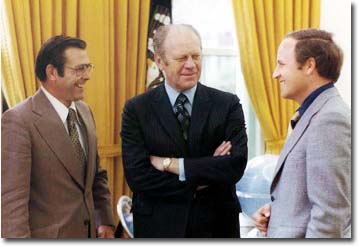
The speech further reveals that BushCo’s zeal to dismantle FOIA has roots that go back to the Ford Administration when Ford was talked out of signing legislation that would have strengthened the act. This feat of persuasion was carried out by his chief of staff, Donald Rumsfeld, and his deputy chief of staff, Dick Cheney (with additional help from Justice Department lawyer, Antonin Scalia).

Ford’s brain trust has ascended to even higher plateaus of power and their penchant for secrecy has not abated. Rumsfeld’s Pentagon was recently exposed for having paid Iraqi news outlets to publish positive stories written by American PR consultants. Cheney successfully defended his efforts to keep secret the names of corporate energy honchos whom he met with to craft energy policy. That defense included a Supreme Court victory partly decided by his other hunting pal, Antonin Scalia (with whom he was hunting just weeks before Scalia would rule on his case).

The administration is getting help from outside its own coven. The White House’s exposure to the NSA wiretapping scandal is being protected by friendly committee chairs in Congress who have agreed not to initiate oversight hearings. And the scandal itself was hidden from the public by the New York Times, who sat on the story for over a year at the President’s request. This may be the most forboding aspect of the whole affair. When the press joins the conspiracy to keep Americans in the dark about government initiatives conducted in their name, we are truly approaching the end of our brief experiment in the rule of the people.

DeadLines

Kucinich & Co. Take L.A. Times To Task For Scheer Dismissal
We, as Members of Congress, object to the dismissal of Robert Scheer, a 32-year veteran of the LA Times with a long history of excellence in reporting and op ed pieces.

Koppel Floating Idea For New Show Called The F-ing Media
TV never looks at itself hard. We want to answer such questions as, ‘Why is 24-hour cable news “blondes reporting on missing blondes”?

Newspapers Dispelling the Myth of Readership Decline – By Counting Online Readers

For years, publishers have relied — often to their detriment — upon the metric of paid circulation. But circulation for the core product has been on a long, steady decline, causing some to suggest that print is on its way out.

Time Warner Hosts Off The Record Conference with Justice Scalia
He was the latest guest in a Time Warner series of interviews conducted by Norman Pearlstine, the departing editor in chief of Time Inc. Just before the program began on Monday, Richard D. Parsons, chairman of Time Warner, told the audience of more than 100 journalists and businesspeople that what was said was off the record.

Reporters Given 180 Minutes of Access to 470 pages of Alito Documents
How nice of the Justice Department, thanks to a FOIA request, to make legal documents related to Judge Alito available, on a very limited basis today.

FCC Is Expected To Back ‘A La Carte’ Pricing For Cable Networks
FCC Chairman Kevin Martin is expected to announce Tuesday that the commission will soon revise the conclusion it reached in the report it issued last year

Feds won’t block merger of Village Voice Media and New Times
The federal government has declined to intervene in the merger of New York-based Village Voice Media, which owns Seattle Weekly and five other publications, with Phoenix-based New Times, which owns 11 weeklies – clearing the way for the two companies to become one as soon as paperwork is complete.